
Overview of SIM vs eSIM vs iSIM Technologies
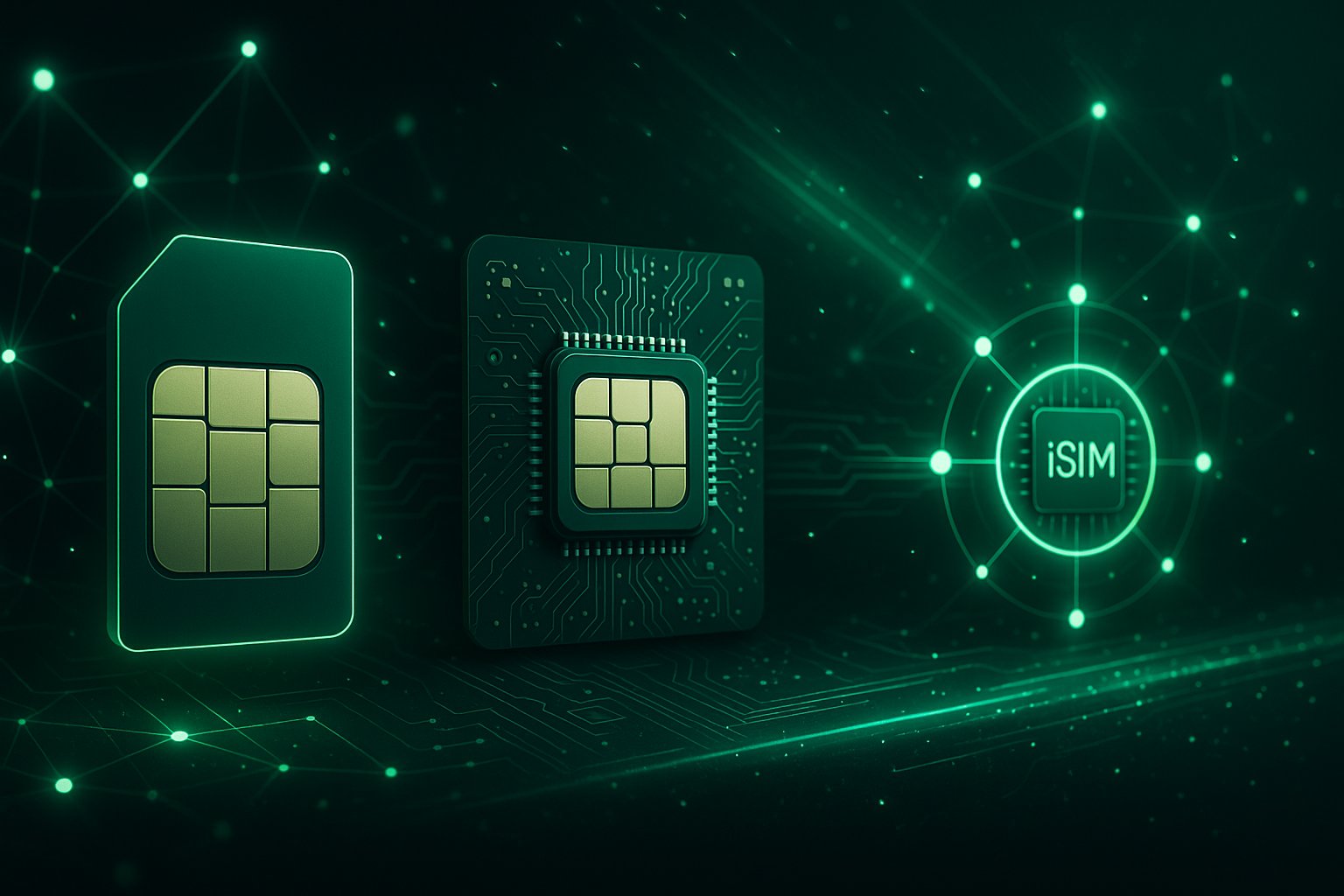
At their core, SIM technologies enable subscriber identification and authentication on cellular networks. The key differences lie in their physical form, integration level, and management capabilities:
- Physical SIM: A removable card with a secure chip that stores the subscriber profile. It requires a dedicated slot and can be physically swapped between devices.
- eSIM: An embedded SIM chip soldered onto the device’s PCB, known as an embedded Universal Integrated Circuit Card (eUICC). It supports remote provisioning and multiple profiles without physical card changes, based on GSMA’s standardized Remote SIM Provisioning (RSP) protocol (SGP.32) enabling secure OTA management of profiles.
- iSIM: The newest form, integrating SIM functionality within the main system-on-chip (SoC) or processor. It eschews separate chips, managing subscriber profiles entirely through software within a secure enclave or Trusted Execution Environment (TEE).
This progression represents a shift from mechanical, removable modules to fully integrated, software-driven identity solutions.
Subscriber Profile Storage and Management
Physical SIM Profile Storage
The physical SIM card contains a dedicated secure memory chip that stores the subscriber identity (IMSI), authentication keys, and operator data. Profile management is inherently manual — changing a subscriber profile requires physically replacing or swapping the SIM card.
eSIM Profile Storage
eSIMs incorporate an embedded UICC (eUICC) chip fixed to the device’s PCB. Subscriber profiles reside securely on this chip, which supports multiple profiles and remote management. The GSMA’s Remote SIM Provisioning (RSP) standard (SGP.32) allows profiles to be securely downloaded, updated, or deleted over the air (OTA), eliminating the need for physical card swaps. This capability is widely adopted in modern smartphones, tablets, and IoT devices.
iSIM Profile Storage
iSIM integrates subscriber profiles inside the main SoC’s secure enclave or Trusted Execution Environment (TEE), such as ARM TrustZone. There is no separate physical SIM chip; profiles are stored and managed purely through software, enabling dynamic updates and instant profile switching. This model enhances flexibility, reduces hardware complexity, and is particularly suited for space- and power-constrained IoT devices.
| SIM Type | Profile Storage Location | Security Boundary |
| Physical SIM | Dedicated secure chip on removable SIM card | Isolated hardware chip with physical security |
| eSIM | Embedded eUICC chip soldered on PCB | Secure element embedded on motherboard |
| iSIM | Integrated secure enclave within main SoC | SoC hardware TEE (e.g., ARM TrustZone) |
Key takeaway: The evolution from physical to embedded SIMs relocates subscriber profiles from removable hardware to integrated secure elements, improving management flexibility and reducing physical security risks.
SIM Activation and Provisioning Processes
Physical SIM Activation
Activation involves physically inserting the SIM card into a device. The device detects the SIM, reads the subscriber data, and registers with the network. Any profile change requires removing and replacing the SIM card, limiting remote management capabilities.
eSIM Activation and Provisioning
eSIMs use GSMA’s Remote SIM Provisioning (RSP) framework (SGP.32), enabling OTA activation and profile downloads. Users typically activate profiles by scanning a QR code or receiving an OTA update from the operator’s Subscription Manager Data Preparation (SM-DP+) server. Devices can store multiple profiles and switch between them without physical intervention, contingent on firmware and OS support. This capability streamlines device provisioning and supports dynamic carrier switching. For operators, these capabilities are closely tied to MVNO provisioning, activation, and the infrastructure required to launch mobile services.
iSIM Activation and Provisioning
iSIM activation is fully integrated into the device’s SoC. Provisioning is software-driven, often via APIs exposed by chipset vendors, allowing instant profile downloads and activation without additional hardware. This enables rapid onboarding, especially advantageous for large-scale IoT deployments and emerging 5G use cases, further simplifying OTA management beyond traditional eSIM capabilities.
| SIM Type | Activation Process | Provisioning Method | Profile Switching |
| Physical SIM | Manual insertion, device detects SIM | Physical SIM card replacement | Manual card swap required |
| eSIM | Scan QR code or OTA download | Remote SIM Provisioning (GSMA SGP.32) | Software-controlled, multiple profiles supported |
| iSIM | Software API-driven activation within SoC | Integrated software provisioning frameworks | Instant switching via software |
Key takeaway: While physical SIMs require manual handling, eSIMs and iSIMs enable remote, software-driven provisioning with increasing speed and operational efficiency.
Device Hardware Requirements and Integration Challenges
Physical SIM Hardware Needs
Devices must incorporate a SIM slot and reader mechanism, adding mechanical and electrical complexity. The slot occupies physical space and introduces potential points of failure. Standard SIM sizes (mini, micro, nano) constrain device design and limit miniaturization.
eSIM Hardware Requirements
eSIMs require an embedded eUICC chip soldered on the PCB, plus firmware and OS support for remote provisioning. Eliminating the SIM slot frees space but demands more complex PCB design and integration. Legacy devices may face compatibility and repairability challenges.
iSIM Hardware Integration
iSIM eliminates the need for a separate SIM chip or slot by embedding SIM functions inside the SoC. This reduces Bill of Materials (BOM), device footprint, and mechanical complexity. However, chipset vendors must integrate and certify SIM logic within their SoCs, which requires industry coordination and adoption. iSIM integration benefits IoT and compact devices by reducing hardware and power demands significantly. The shift toward integrated connectivity is also influencing how modern telco stacks support increasingly software-driven network architectures.
| SIM Type | Hardware Components | Integration Complexity | Device Repairability Impact |
| Physical SIM | SIM slot, card reader, removable card | Moderate; mechanical parts increase complexity | High; SIM card easily replaceable |
| eSIM | Embedded eUICC chip on PCB, no slot | Higher; PCB redesign, firmware/OS support needed | Moderate; no removable card but replaceable PCB |
| iSIM | SoC with integrated SIM logic, no additional chips | High; requires chipset vendor cooperation and certification | Low; no physical SIM component to replace |
Key takeaway: Hardware demands decrease progressively from physical SIM to iSIM, enhancing device miniaturization but increasing integration complexity and dependency on chipset vendors.
SIM Security Features and Implications
Physical SIM Security
Physical SIMs house a dedicated secure element with proven cryptographic protections. Physical removal can pose risks such as theft or loss but the hardware separation provides strong tamper resistance.
eSIM Security Enhancements
Embedded secure elements in eSIMs maintain tamper resistance and support secure OTA updates. The reduced physical access lowers tampering risk, but security depends more on device firmware and OS integrity. The GSMA RSP standard enforces strong cryptographic protocols for profile download and management.
iSIM Security Considerations
iSIM leverages SoC secure enclaves or Trusted Execution Environments (TEEs), benefiting from modern hardware security features like ARM TrustZone. The co-designed hardware-software model can reduce attack surfaces but also concentrates risk if SoC vulnerabilities arise. Mitigation involves rigorous chipset security certification, secure boot processes, and software hardening. The integrated nature requires comprehensive lifecycle security management.
| SIM Type | Cryptographic Capability | Physical Tamper Resistance | Attack Surface |
| Physical SIM | Strong hardware-based crypto | High (dedicated secure chip) | Limited to SIM card and reader |
| eSIM | Advanced secure element with OTA key provisioning | High (embedded chip) | Dependent on device firmware security |
| iSIM | Integrated crypto within SoC TEE | Moderate to high (SoC secure enclave) | Broader SoC attack surface; mitigated by hardware/software co-design |
Key takeaway: Security remains robust across all SIM types, with evolving trade-offs between physical isolation and integration-driven attack surfaces.
Flexibility, Space, and Power Consumption
Flexibility Comparison
- Physical SIM: Least flexible; swapping requires physical access.
- eSIM: Supports multiple profiles with remote switching, enhancing user flexibility.
- iSIM: Maximizes flexibility with software-defined profiles and instant provisioning.
Space Considerations
- Physical SIM: Largest due to card and slot.
- eSIM: Smaller footprint; no slot but separate chip.
- iSIM: Minimal footprint as SIM is SoC-integrated.
Power Consumption
- Physical SIM: Consumes power during card communication; less efficient.
- eSIM: Lower power than physical SIM but still separate hardware.
- iSIM: Lowest power due to integration and optimized SoC design.
| SIM Type | Flexibility | Space Footprint | Power Consumption |
| Physical SIM | Low (manual swap only) | Largest (card + slot) | High (dedicated chip communication) |
| eSIM | High (remote provisioning, multiple profiles) | Medium (chip on PCB, no slot) | Medium (embedded chip) |
| iSIM | Very High (software-defined profiles) | Minimal (integrated in SoC) | Low (optimized SoC integration) |
Key takeaway: iSIM offers the best combination of flexibility, compactness, and power efficiency, critical for modern device design.
Practical Use Cases and Technology Suitability
When to Choose Physical SIM
- Legacy devices or networks that require removable SIMs.
- Situations where frequent physical SIM swapping is needed, such as traveler SIM cards.
- Devices lacking firmware or OS support for embedded SIMs.
Ideal Use Cases for eSIM
- Smartphones, tablets, and wearables benefiting from remote provisioning and dual profiles.
- Devices requiring flexible network switching without physical access.
- Mid- to high-end consumer electronics balancing integration and user flexibility.
- IoT devices that require secure remote management but can accommodate separate eUICC chips.
Optimal Scenarios for iSIM Deployment
- IoT devices demanding minimal hardware size and low power consumption.
- Mass-market deployments that benefit from rapid, software-driven provisioning.
- Next-generation 5G devices and advanced security-sensitive applications.
- Connected cars, industrial sensors, and compact consumer electronics where integration and security are paramount.
These characteristics make iSIM particularly relevant to MVNO IoT connectivity and large-scale connected device deployments.
| SIM Type | Typical Devices | Use Case Examples |
| Physical SIM | Feature phones, legacy smartphones, industrial modems | Travel SIM cards, devices without embedded SIM support |
| eSIM | Modern smartphones (e.g., Apple iPhone, Google Pixel), wearables, tablets, IoT devices with eUICC | Remote carrier switching, multi-profile devices, corporate phones, IoT managed remotely |
| iSIM | IoT sensors, connected cars, industrial devices, future smartphones | Massive IoT deployments, instant provisioning, space-constrained devices |
Key takeaway: Selecting a SIM technology depends on device capability, required flexibility, and deployment scale, with iSIM poised to drive next-gen connectivity.
Comprehensive Comparison Table: SIM vs eSIM vs iSIM
| Parameter | Physical SIM | eSIM | iSIM |
| Subscriber Profile Storage Location | Dedicated chip on removable card | Embedded eUICC chip on PCB | Secure enclave within SoC |
| Profile Management Method | Manual card swap | Remote SIM Provisioning (OTA, QR codes, GSMA SGP.32) | Software-defined, API-driven |
| Activation / Provisioning Process | Physical insertion and detection | OTA download via SM-DP+ server | Integrated software provisioning frameworks |
| Hardware Requirements | SIM slot, card reader | Embedded chip, no slot | SoC integration, no separate SIM chip |
| Security Features | Hardware secure element, physical tamper resistance | Embedded secure element, OTA key management | SoC TEE, hardware-software co-design |
| Flexibility (Profiles & Switching) | Low (manual only) | High (multiple profiles, remote switching) | Very high (instant software switching) |
| Space Footprint | Largest (card + slot) | Medium (chip only) | Minimal (SoC integrated) |
| Power Consumption | High (separate chip communication) | Medium (embedded chip) | Low (optimized SoC design) |
| Typical Device Types / Use Cases | Legacy phones, industrial modems | Modern smartphones, tablets, wearables, IoT devices | IoT devices, connected cars, future smartphones |
Conclusion
Understanding the differences between physical SIM, eSIM, and iSIM technologies is essential for telecom professionals tasked with device design, provisioning, and security strategies. Physical SIMs offer simplicity and mature security but limited flexibility and larger hardware footprints. eSIMs strike a balance with embedded hardware enabling remote management and multiple profiles, ideal for modern consumer and IoT devices. iSIMs represent the cutting edge—integrating SIM functionality within the SoC to maximize flexibility, minimize size and power consumption, and streamline provisioning.
The choice among these SIM types depends on device requirements, security posture, provisioning needs, and manufacturing considerations. As iSIM adoption grows, driven by GSMA standards and chipset vendor support, it is expected to reshape the SIM landscape, especially for IoT and next-generation mobile devices.
Telecom professionals should evaluate SIM technology choices carefully, prioritizing the criteria outlined here to optimize network connectivity solutions for their specific application domains.
Frequently Asked Questions (FAQ)
What are the main differences between SIM, eSIM, and iSIM?
Physical SIM is a removable card storing subscriber data; eSIM is embedded on the device PCB allowing remote provisioning; iSIM integrates SIM functionality into the main SoC enabling software-driven profile management with minimal hardware.
How does eSIM activation differ from physical SIM activation?
Physical SIM activation requires inserting the SIM card manually, while eSIM activation uses remote provisioning via QR codes or OTA downloads, allowing multiple profiles without physical card swaps.
What security advantages does iSIM offer compared to other SIM types?
iSIM uses a secure enclave within the SoC (e.g., ARM TrustZone) for cryptographic functions, offering strong hardware-software co-designed security, though it requires rigorous certification to mitigate SoC vulnerabilities.
Which SIM technology offers the best power efficiency?
iSIM provides the lowest power consumption due to its integration within the SoC and optimized design, outperforming both physical SIM and eSIM in energy efficiency.
Can eSIM and iSIM support multiple subscriber profiles?
Yes, both eSIM and iSIM support multiple profiles with remote switching capabilities, offering greater flexibility compared to physical SIM which requires manual swapping.
What hardware changes are needed to support iSIM in devices?
iSIM requires chipset vendors to integrate SIM logic within the SoC, eliminating separate SIM chips or slots, which reduces hardware complexity but demands vendor cooperation and certification.
In which scenarios is a physical SIM still preferred?
Physical SIMs remain preferred for legacy devices, networks lacking embedded SIM support, and situations requiring frequent physical SIM swaps, such as traveler SIM cards.
How does remote provisioning work for eSIMs?
eSIMs use GSMA’s Remote SIM Provisioning (RSP) standard, allowing profiles to be securely downloaded, updated, or deleted over the air via an operator’s SM-DP+ server, enabling seamless OTA management.
What are typical use cases for iSIM technology?
iSIM is ideal for IoT devices needing minimal size and power, mass-market rapid provisioning, next-gen 5G devices, connected cars, and secure industrial sensors where integration and efficiency are critical.
How does the physical size of SIM types compare?
Physical SIMs have the largest footprint due to the card and slot; eSIMs have medium size with embedded chips on PCB; iSIMs have minimal footprint as SIM functionality is integrated into the SoC.
What impacts device repairability among SIM types?
Physical SIMs offer high repairability with easy card replacement; eSIMs moderate repairability as embedded chips are soldered but PCBs can be replaced; iSIMs have low repairability since SIM is integrated into the SoC with no physical parts.